How to split a bill with tip
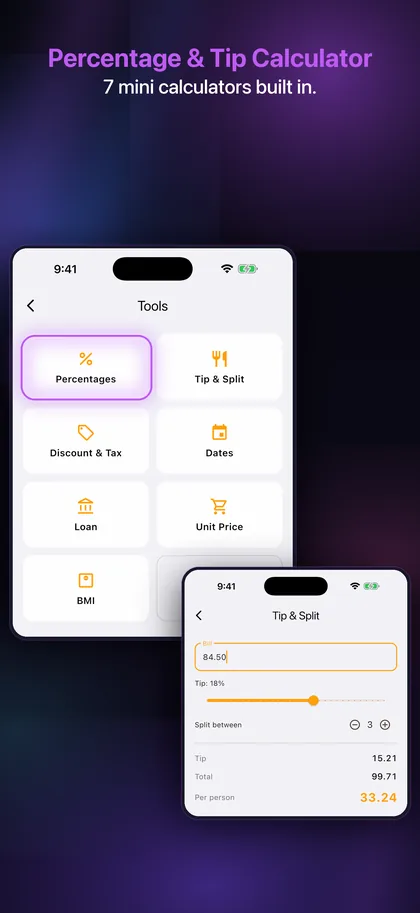
Short answer. Multiply the bill by the tip percentage, add that to the bill, then divide by the number of people. An 84.50 bill at 18% has a tip of 15.21, a total of 99.71, and comes to 33.24 each between three. Round each share up, not down, or the table pays less than the total.
The three steps
Bill              84.50
Tip 18%           84.50 × 0.18  =   15.21
Total             84.50 + 15.21 =   99.71
Split 3 ways      99.71 ÷ 3     =   33.236666...
Per person        33.24
That is the whole thing. The only place it gets interesting is the last line, where the division does not come out even.
The cent that goes missing
99.71 divided by three is 33.236666… repeating. It never terminates, so somebody has to round, and the direction matters:
| Each pays | Table pays | Against the 99.71 total |
|---|---|---|
33.23 (rounded down) | 99.69 | 2 cents short |
33.24 (rounded up) | 99.72 | 1 cent over |
Round up. The extra cent lands in the tip, where nobody minds it. Round down and the card gets declined for a two cent shortfall, which is a very stupid way to end a dinner.
This is also the exact scenario where a calculator quietly lying to you costs real money. If the app rounds 33.236666… to 33.24 and then also stores 33.24 as its internal value, adding those three shares back gives 99.72 and the total no longer matches the bill. That drift is the same floating point rounding error that makes 0.1 + 0.2 come out as 0.30000000000000004, and it is why arithmetic that stays exact until the moment it is displayed is worth caring about.
Before or after tax?
The convention in the United States is to tip on the pre-tax subtotal. In practice most people tip on whatever number is printed largest, because the difference is usually under a dollar and nobody wants to do two calculations at a table. Either is defensible. Tipping on the pre-tax amount is the one you can argue for.
Doing it in your head
You rarely need the exact number, only a number that is not embarrassing. For 18%, take 10% by moving the decimal one place left, halve that for 5%, halve again for 2.5%, then add:
10% of 84.50   =  8.45
 5%            =  4.23
 2.5%          =  2.11
──────────────────────
17.5% ≈           14.79   (close enough to 18%)
For 20% it is easier still: move the decimal one place and double it. 84.50 → 8.45 → 16.90. That is why 20% has quietly become the default tip in the US. It is not generosity, it is arithmetic that fits in your head.
Quick reference
The same three rates on common bill sizes, rounded to the cent:
| Bill | 15% | 18% | 20% |
|---|---|---|---|
| 25.00 | 3.75 | 4.50 | 5.00 |
| 50.00 | 7.50 | 9.00 | 10.00 |
| 84.50 | 12.68 | 15.21 | 16.90 |
| 100.00 | 15.00 | 18.00 | 20.00 |
When the shares should not be equal
An even three-way split assumes everyone ate roughly the same. When one person ordered the steak, split proportionally instead: each person pays their own share of the subtotal, scaled up by the same tip.
One person's food     40.00 of the 84.50 subtotal
Their share           99.71 × 40.00 ÷ 84.50  =  47.20
The other two split   99.71 − 47.20  =  52.51  →  26.26 each
Rounded up, the table pays 99.72 again, one cent over, and the cent lands in the tip exactly as before. The proportion trick works for any number of people because the tip scales everyone's share by the same factor, so nobody subsidises the steak.
Or let it do the rounding
Prism has a tip and split calculator built in, along with six others. Free, no subscription. See the app.